


Bolivia is recognized as one of the most megadiverse countries in the world. It harbors unique natural treasures thanks to its varied ecoregions, such as the Serranía de Sunsas, located in Ángel Sandoval Province in the department of Santa Cruz. This natural area was declared a Municipal Protected Area at the end of 2025 and encompasses 86,509.01 hectares under conservation status.
This territory hosts Chiquitano dry forest and Cerrado ecosystems, directly connecting with the Pantanal, recognized as a Ramsar Site. Together, they form a natural corridor that ensures the continuity of the water cycle and safeguards three unique landscapes with extraordinary biodiversity, including emblematic species of flora and fauna. In the Chiquitano region alone, 547 bird species have been documented (Hennessey et al., 2003), representing 37% of Bolivia’s national avifauna (Herzog, 2021).
Ecological and Cultural Value
Sunsas stands out as a space of enormous ecological and cultural value. “As community members, we are aware that protected areas benefit our communities and the region in every way,” emphasizes Cacique Santiago Salvatierra of the Land and Territory portfolio of the Indigenous Reivindicative Central of Ángel Sandoval Province (CIRPAS), representing the Santo Corazón Community.
The declaration was carried out within the framework of the Conserva Aves Initiative, marking a decisive step toward a sustainable future by integrating bird conservation with the well-being of local communities.
Thanks to two monitoring campaigns conducted by the Noel Kempff Mercado Natural History Museum, 176 bird species were recorded, belonging to 22 orders, 43 families, and 148 genera. Among the most notable and representative species are:
- Green-cheeked Parakeet (Pyrrhura molinae)
- Crested Oropendola (Psarocolius decumanus)
- Blue Ground Dove (Claravis pretiosa)
- Bare-faced Curassow (Crax fasciolata)
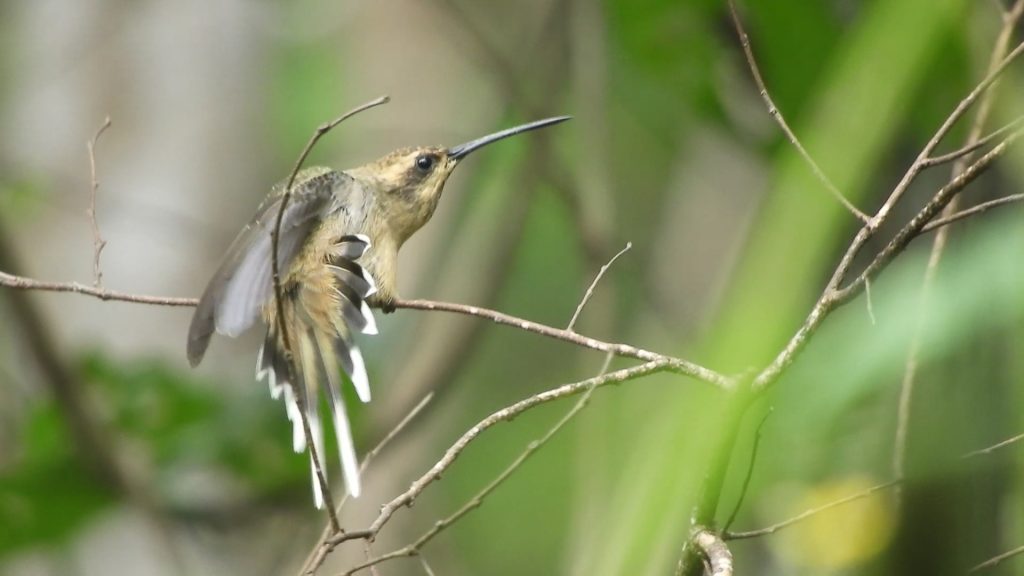
Photo: Noel Kempff Mercado Museum. Buff-bellied Hermit (Phaethornis subochraceus)
Community Governance
The process was the result of nearly two years of outreach and consensus-building among communities and municipal, departmental, and national authorities. The Sunsas Steering Committee—composed of the communities of San Fernando, Pozones, Santo Corazón, Bahía Negra, and Beya Boca, together with CIRPAS, the Municipal Government of San Matías, the San Matías ANMI, the Sub-Governorship of Ángel Sandoval Province, and the Natural Heritage Conservation Directorate (DICOPAN) of the Santa Cruz Governor’s Office—reflects a model of local governance that strengthens conservation and citizen participation.
“By benefiting our community members, we fulfilled our duty as the Municipal Council by signing the Law Declaring the Serranía de Sunsas Protected Area, at the request of our people who recognize the value of safeguarding natural resources,” highlights Fredy Román, President of the San Matías Municipal Council.
Social and Environmental Impact
The new protected area directly benefits the five communities that live in harmony with this unique landscape. For them, conservation is not only environmental—it is also an opportunity to strengthen cultural identity, nature-based tourism, environmental education, scientific research, and sustainable productive projects.
“Through the new protected area, we have greater opportunities for projects to address drinking water access. When drought arrives, we dig wells or ‘pauros’ to get water, and often we have to drink it with dirt,” recounts José Antonio Tomichá, a teacher from the Bahía Negra Community.
Conserving this territory also has global-scale impacts, as it contributes to maintaining the hydrological cycle that benefits other regions and ensures the stability and balance of migratory bird routes across the world.
A Territory Under Pressure: “When the Forest Speaks, the Community Listens”
Sunsas faces threats such as wildfires, intensive cattle ranching, mining, deforestation, and land invasions. The declaration is not merely a legal designation—it is a shield for life and a large-scale commitment in the face of the climate crisis.
Following the official declaration of the Serranía de Sunsas Protected Area, and with a management plan, a strategic financial plan, and a Management Committee already in place, immediate steps must focus on operational implementation, institutional coordination, and community participation.
The goal is to ensure that designed strategies translate into concrete conservation and collective well-being actions, linking the protected area with sustainable development plans through the design and implementation of productive projects and the provision of basic services. All of this must be carried out through biodiversity- and water-compatible mechanisms, while promoting birdwatching tourism and environmental education as pillars of sustainability and social ownership.
After the declaration, the challenge is no longer regulatory but executive and participatory. It is about moving from paper to action, ensuring that management is sustainable, inclusive, and delivers visible results for biodiversity and communities.
About the Conserva Aves Initiative
The Conserva Aves Initiative is led by American Bird Conservancy, National Audubon Society, BirdLife International, Birds Canada, and RedLAC, with support from the Bezos Earth Fund, promoting the creation of subnational protected areas adapted to each territory. In Bolivia, implementation is led by FUNDESNAP and Asociación Civil Armonía. Sunsas received technical operational support from Fundación CERAI, as well as backing from The Pew Charitable Trusts.
The creation of the Serranía de Sunsas Protected Area is a celebration of unity between nature and community, a symbol of climate resilience, and an example of how local governance can shape the future of ecosystems while generating global impact.
Note: Katia Garrido, CERAI / Reviewed by the Conserva Aves and Pew teams