

In the south of Cochabamba, in the town of Omereque, the majestic flight of the Red-fronted Macaw (Ara rubrogenys), an endemic and endangered species, has become the region’s main tourist attraction. Yet it is not the only treasure this territory holds. Along the banks of the Mizque River, rock paintings and ancient ruins remain largely unnoticed, safeguarding a millennia-old heritage that still has many stories to tell. For archaeologist Ricardo Céspedes, this legacy could become a key opportunity for cultural tourism.
Céspedes, who has worked in the area since the 1980s, believes that Omereque is one of Bolivia’s most fascinating archaeological regions due to the diversity of ceramics, rock art, and architectural remains it contains. “The importance of Omereque begins with archaeology. As early as 1982, the Omereque culture was described and its potential was assessed, revealing numerous rock paintings, such as camelid representations in the Ventanas sector and in Pukara, near the community of San Carlos, where the iconography helps us understand how these cultures developed,” said Céspedes.
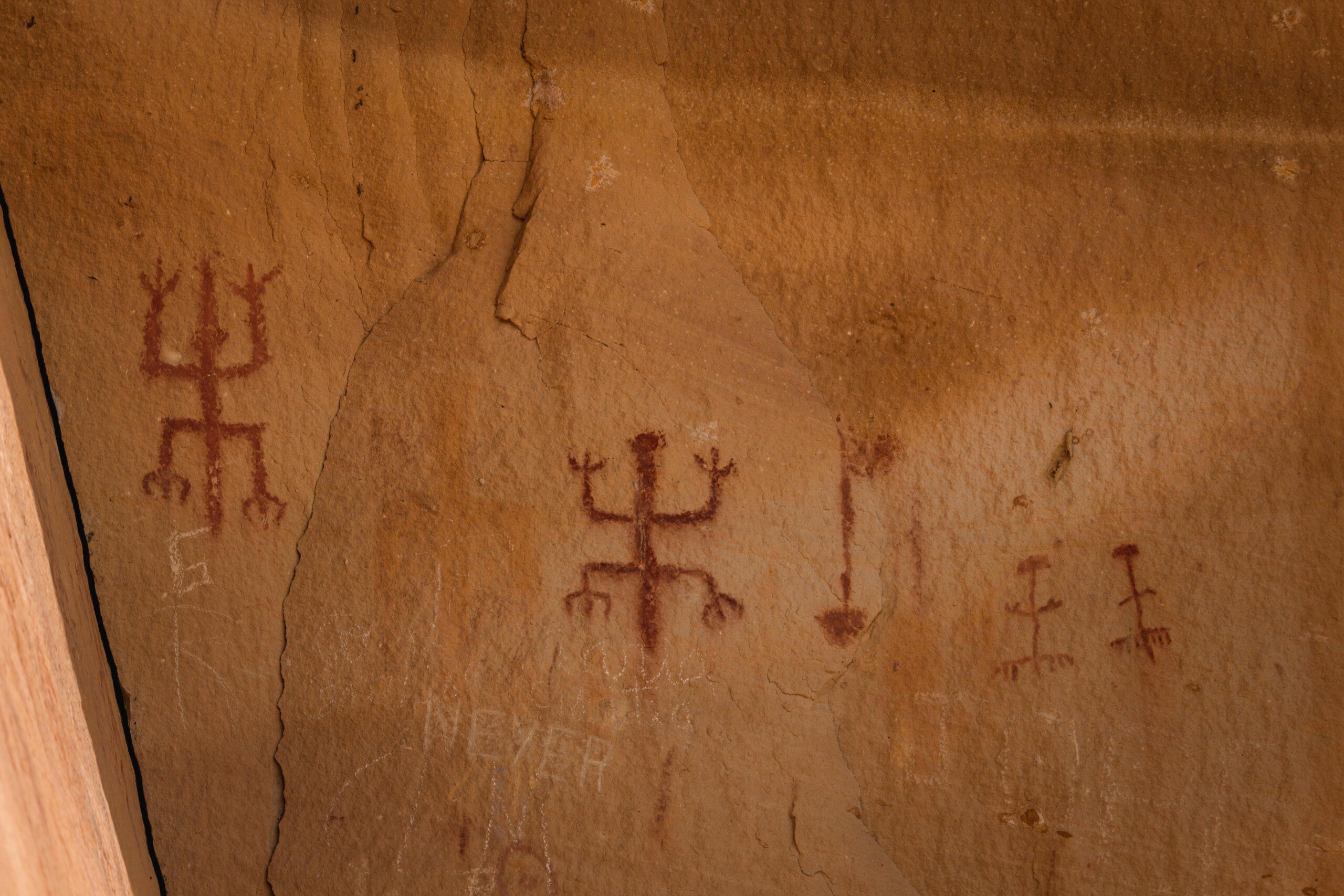
Among these artistic expressions, amphibians stand out. Their presence in the rock paintings reveals the deep understanding these cultures had of their environment. According to Céspedes, these animals played a crucial role in predicting natural cycles. “When many frogs or toads appeared gathered in one place, people knew there would be no rain. On the other hand, when they did not see them, it signaled a good rainy season.”
This behavior, he explains, is linked to the biology of these species: during dry periods, they congregate in humid areas, while in rainy seasons they disperse. These observations were immortalized in images “that can be found along the entire Mizque River.”

The Mizque River, surrounded by history, rock art, and archaeological sites. Photo: Armonía.
Tunas M’oko and Pukara: The Essential Archaeological Route
Tunas M’oko is one of the most important sites for understanding Omereque’s past. This ancient stone-walled complex sits on a hill near the community of San Carlos, seven kilometers southeast of the town. The fortress, one of the best-preserved in the region, is located within the Red-fronted Macaw Community Nature Reserve, home to the largest breeding colony of this endemic and critically endangered Bolivian species.
This combination makes the site a must-visit destination: visitors drawn by birdwatching can also explore an archaeological site of great significance, where nature and ancestral memory intertwine.

Remains of the Tunas M’oko wall within the Red-fronted Macaw Community Nature Reserve. Photo: Armonía.
“Thanks to the work of Armonía, the ecological importance of the area began to be recognized, and this cliff formation was identified. Through these efforts, it was established as a natural park that also protects a key archaeological site: Tunas M’oko, a ruin that has yet to be excavated or restored,” commented Céspedes.
According to the Archaeological Guide to Omereque, written by Céspedes in collaboration with Armonía, at the summit of this ancient site “there are remains of structures and house foundations, with very few cultural artifacts found, suggesting that this fortress was only used during invasions by other ethnic groups. (…) Storage silos and agricultural terraces were built there, enabling refugees to survive for several months while under siege by enemies advancing along the banks of the Mizque River.”

The Red-fronted Macaw Community Nature Reserve protects the endangered Red-fronted Macaw, as well as valuable archaeological sites and unique landscapes. Photo: Teodoro Camacho, Armonía.
Another key stop along this route is Pucara Hill, located on the northern bank of the Mizque River. There, visitors can observe ceremonial structures, residences of important figures, and, on the southern slope, rock paintings depicting lizards, human figures, and celestial bodies in shades of crimson red, dark red, and orange. These images provide further insight into the symbolic universe of these ancient cultures.
The “Magical” Connection Between Willca and Omereque Ceramics
“One of the most interesting things that happened in Omereque was the use of Willca,” said Céspedes, explaining that it is a plant whose seeds possess hallucinogenic properties. During the Omereque period, it was used in religious rituals to establish contact with the gods. “This is reflected, for example, in the snuff spoons used to consume the powdered substance,” he added.
The use of Willca was not unique to this region. Its presence extends from Argentina to the Orinoco Basin as part of ritual practices among different cultures. However, in Omereque, this element takes on particular significance because, according to Céspedes, it may be linked to the polychromatic and abstract nature of local ceramics, possibly influenced by the hallucinogenic experiences associated with the plant.

Ricardo Céspedes, archaeologist and director of the Alcide d’Orbigny Natural History Museum, speaking at the conference on archaeology and biodiversity conservation in Omereque. Photo: Marizol Huarachi, Armonía.
Investing in Knowledge-Based Tourism
Today, most visitors to Omereque come primarily for birdwatching. However, Céspedes advocates expanding the tourism offer toward a knowledge-based model that integrates the area’s archaeological, natural, and cultural wealth. “The most important thing is for people to discover all of it,” he said.
According to Céspedes, this approach would diversify tourism and create new economic opportunities for local communities, particularly in areas where agriculture is not a constant source of income.
“For example, there is a plant that was traditionally used to make spoons. We can take advantage of these resources so that tourists not only learn about environmental conservation but also about products and traditions that have been forgotten. Archaeological information can help recover this knowledge and transform it into an opportunity to attract visitors and generate income.”
To achieve this, he concludes, it is essential to strengthen awareness of the value of local heritage: “We want the people of Omereque themselves to take ownership of their culture.”
Article written by Nicole Laura and published in Los Tiempos.
Cover photo: Rock paintings depicting amphibians in the community of Pucara, Omereque. Photo: Daniel Aguilar, Armonía.