

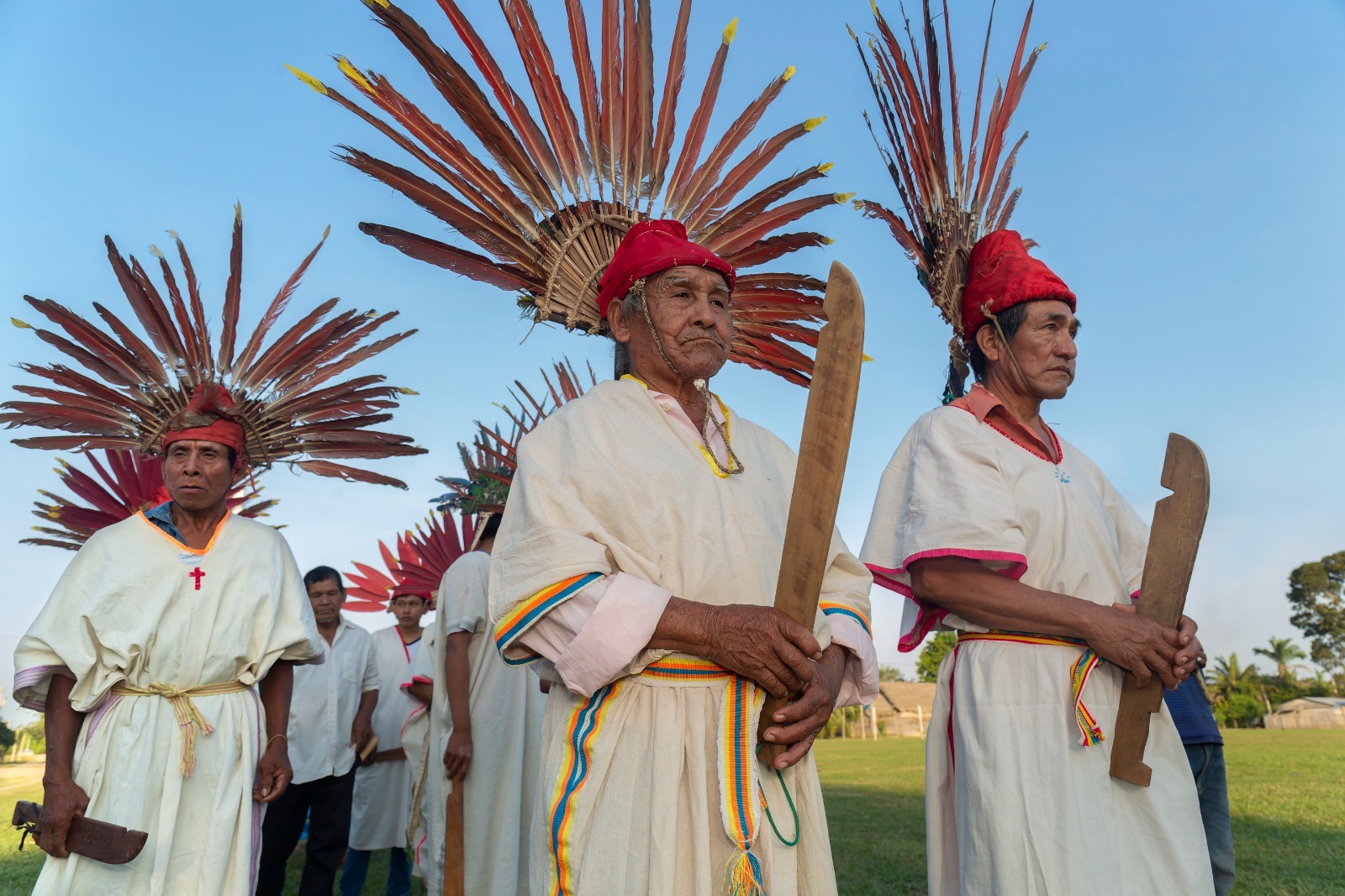
“Loma Santa was the promised land our ancestors searched for but never found,” recalled Alfredo Matareco, chief of the Autonomous Indigenous Government of the Multiethnic Indigenous Territory (TIM), before authorities and delegates from the 28 communities gathered at a meeting of community leaders. The gathering—which the peoples of the TIM hold two or three times a year—took place on August 19, 2025, when the leaders were discussing, among other matters, a crucial issue: the law governing the territorial control and monitoring system. Afterwards, they proceeded with the ceremony dedicated to Loma Santa.
To provide context for the guests attending the event, Matareco reflected on history: after the Jesuit reductions, many communities returned to the forest in search of a spiritual and autonomous refuge. During that journey, the aspiration for a sacred place took shape—a place of profound spiritual value where peace, food, health, and dignity could be found. Today, centuries later, Loma Santa belongs to them and represents a milestone in the struggle for self-determination and the strengthening of Indigenous autonomy.
The ceremony in Monte Grande marked the official launch of the Loma Santa Historical, Cultural, Social, and Spiritual Heritage Conservation Area, registered on June 26, 2025, as the first protected area established by an Indigenous autonomous government in the Bolivian Amazon and the fifth of its kind recognized by Bolivia’s National Service of Protected Areas. Covering 198,778 hectares, the new protected area safeguards forests, rivers, and savannas that harbor exceptional biological richness. At least 279 bird species have been recorded in Loma Santa, a key indicator of the area’s remarkable biodiversity and its importance for conservation in the Bolivian Amazon, in addition to its profound history of Indigenous resistance.
“This has been a very long process experienced by the five peoples of this territory to consolidate our legitimacy and live in harmony with nature,” added Matareco, summarizing in a single sentence the deeper meaning of this collective achievement by the Mojeño-Trinitario, Mojeño-Ignaciano, T’simane, Yuracaré, and Movima Indigenous communities.

That same day, we traveled in a caravan from San Ignacio de Mojos to Monte Grande. Upon arrival, we headed to the Control Post, where Santos Muiba and Yoana Gualu welcomed us and showed us how their weather station operates. Through it, they monitor climate variations and can issue early warnings in the event of wildfires, such as those that devastated the region in 2023. Monitoring shifts are periodically shared among community members in a collective effort sustained with limited resources but driven by the deep conviction that protecting the forest means protecting their home.

The site also reflects the way the TIM manages its territory. Large maps cover the walls, showing the communities within the territory, neighboring municipalities, the Isiboro Sécure Indigenous Territory and National Park (TIPNIS), and the Chimán Territory. A shortwave radio connects the post with other communities, and thanks to a solar panel system, the station has electricity and satellite internet access.
“This is a strategic location for controlling illegal activities and monitoring the conservation status of forests and rivers,” explains Miguel Fernández, a biologist with ORE, referring to the territorial control and monitoring system that combines community-based monitoring with technology.
The official celebration of Loma Santa featured children performing the Toritos Dance with miniature bull masks, elders leading the Macheteros Dance, and park rangers entering with bows and arrows. There are 60 volunteer rangers. None of them receives a salary; they do it because protecting the territory means defending the lives of their families.

Alfredo Matareco summarized it in Monte Grande: “Today we continue the efforts of our ancestors. Consolidating a territory has not been easy, but now we have a Law that guarantees our existence, our food security, and our autonomy. The conservation area is a collective achievement.”
To the south of Loma Santa lies the Isiboro Sécure Indigenous Territory and National Park (TIPNIS). Indigenous marches in 2011 and 2012, opposing the construction of a highway that would have crossed the park, succeeded in halting the project.
“Today it will be much more difficult to build that highway because there is now a conservation area called Loma Santa, which functions as a kind of barrier. That decision opened the path toward autonomy and now guarantees conservation,” explains Catalina Rivadeneira, ORE’s Amazon Program Coordinator, on the evening before the event.

According to Leonardo Tamburini, Executive Director of ORE, this is a strategic effort aimed at strengthening and supporting Indigenous organizations and governments in the full exercise of their rights, while simultaneously consolidating governance structures for the conservation of their territories and the natural resources that sustain them, creating opportunities for development.
Conserva Aves Bolivia Strengthens Subnational Protected Areas in the Country
This designation was made possible through the hemispheric conservation initiative Conserva Aves, led by American Bird Conservancy, National Audubon Society, BirdLife International, Birds Canada, and RedLAC. The initiative seeks to protect areas of exceptional biodiversity value while promoting climate resilience, sustainable development, and community well-being. In Bolivia, it is implemented by Asociación Armonía and FUNDESNAP with support from the Bezos Earth Fund.
More than a year after the launch of Conserva Aves Bolivia, the projects supported by the initiative have entered a key stage of consolidation. Among the most important milestones are the establishment and strengthening of the Loma Santa Conservation Area through the Autonomous Indigenous Government of the TIM, the TIM Indigenous Council Subcentral, the TIM Women’s Subcentral, and ORE (Legal and Social Support Organization), which has supported this process for several years.
Another significant achievement is the creation of the Serranía de Sunsás Subnational Protected Area in the municipality of San Matías, promoted by CERAI. Together, these efforts represent important advances in strengthening subnational conservation in Bolivia. At the same time, other initiatives continue preparing the declaration of new protected areas.
Sebastián Herzog, Director of the Latin America and Caribbean Protected Areas Initiative at the National Audubon Society, explained that Loma Santa is currently the first Amazonian conservation area supported by Conserva Aves, which is implemented across Latin America and the Caribbean. It is also the first area established through the initiative in Bolivia and, to date, the largest, representing 10% of the global goal of protecting two million hectares.
At the end of the event, the play Voices of the TIM was presented, directly addressing the conflicts generated by “development” projects in Indigenous territories. In the story, a bridge is built at the cost of sacrificing forests and wildlife, reflecting what many consider the contradictions of extractivist development. “The lie of development,” one passage concludes, challenging external promises against the realities of community life.
Conserva Aves
This new refuge was established within the framework of the Conserva Aves Initiative, led by American Bird Conservancy, National Audubon Society, BirdLife International, Birds Canada, and the Latin American and Caribbean Network of Environmental Funds (RedLAC). In Bolivia, the initiative is led by the Foundation for the Development of the National System of Protected Areas (FUNDESNAP) and Asociación Armonía, and implemented by the Legal and Social Support Organization (ORE), with generous support from the Bezos Earth Fund.
Conserva Aves supports Indigenous Peoples, Afro-descendant communities, NGOs, and community-based organizations in the creation or expansion, management, and long-term sustainability of subnational protected areas in key bird conservation sites (such as Key Biodiversity Areas – KBAs) throughout Latin America.
Documentary Video:
Text: Margarita Palacios, Armonía
Photos: Daniel Alarcón