


The ML Blue-throated Macaw Sound Expedition brought together 12 enthusiasts from different Latin American countries in Beni. It was an experience that blended science, passion, technical training, and international collaboration.
The Macaulay Library Sound Expeditions (ML Sound Expeditions) are recording campaigns aimed at filling strategic gaps in the world’s bird sound archive. On this occasion, organized together with Asociación Armonía and eBird Bolivia, the expedition sought to document the vocalizations of species characteristic of Beni at the Barba Azul Reserve, contributing to the strengthening of the Neotropical sound-recording community.
Over four full days, the team traversed savannas, wetlands, and gallery forests, recording from dawn to dusk. The resulting files were automatically integrated into the Macaulay Library, enriching the global database of Neotropical bird songs. The expedition also recorded the Dwarf Tinamou (Taoniscus nanus) for the first time within the Barba Azul Reserve—one of the rarest and least-known birds in the world.
“Every recording, no matter how brief, has immense value for science,” explains Tjalle Boorsma of Asociación Armonía. “Many rare or hard-to-see species can be detected by ear before sight. Listening is a way of knowing,” he adds.
Rock&Record: passion, technique, and camaraderie
Under the slogan #Rock&Record, introduced by Pablo Gigy Gregoret (Manomet), the group headed into the field each day with energy and good vibes. The goal: to reach 100 recordings per participant, prioritizing key species for Merlin Audio ID. Despite persistent wind and logistical challenges, the team pressed on: more than 250 species were detected during the expedition, of which 181 were recorded.
Colombian participant Mauricio stood out with recordings of more than 108 species, while the rest of the group completed an impressive repertoire of sounds that now strengthens the training of Merlin’s song identification model.
The experience included unforgettable moments, such as watching Blue-throated Macaws (Ara glaucogularis) fly over the reserve’s main island, or the unexpected recording of a beautiful pair of Orinoco Geese (Oressochen jubatus) landing on the roof of the main lodge. Everyone—microphone or cellphone in hand—recorded in unison, just before saying goodbye.
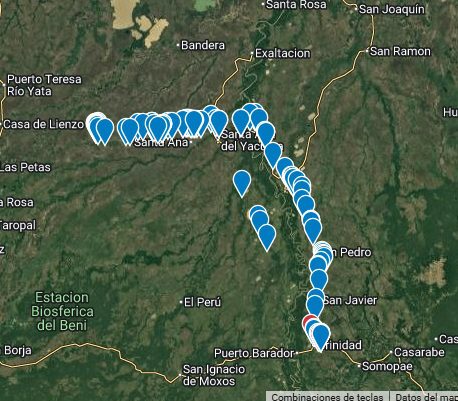
Trip report
You can explore all the records and each participant’s contributions in the eBird Trip Report.
Sharing experiences
One of the most memorable aspects of the expedition was the diversity of the group and the daily exchange of knowledge.
From the local team, Nicole, Miguel, and José Augusto welcomed the rest of the delegation with Bolivian hospitality, sharing their knowledge of local birds along with colorful insights into their culture and cuisine. The group was rounded out by Daisy and Carlos from the Ecuadorian Amazon; Mauricio from Colombia; Cullen from the United States; Giselle, Fabricio, and Pablo from Argentina; and Pierina and Priscila from Peru.
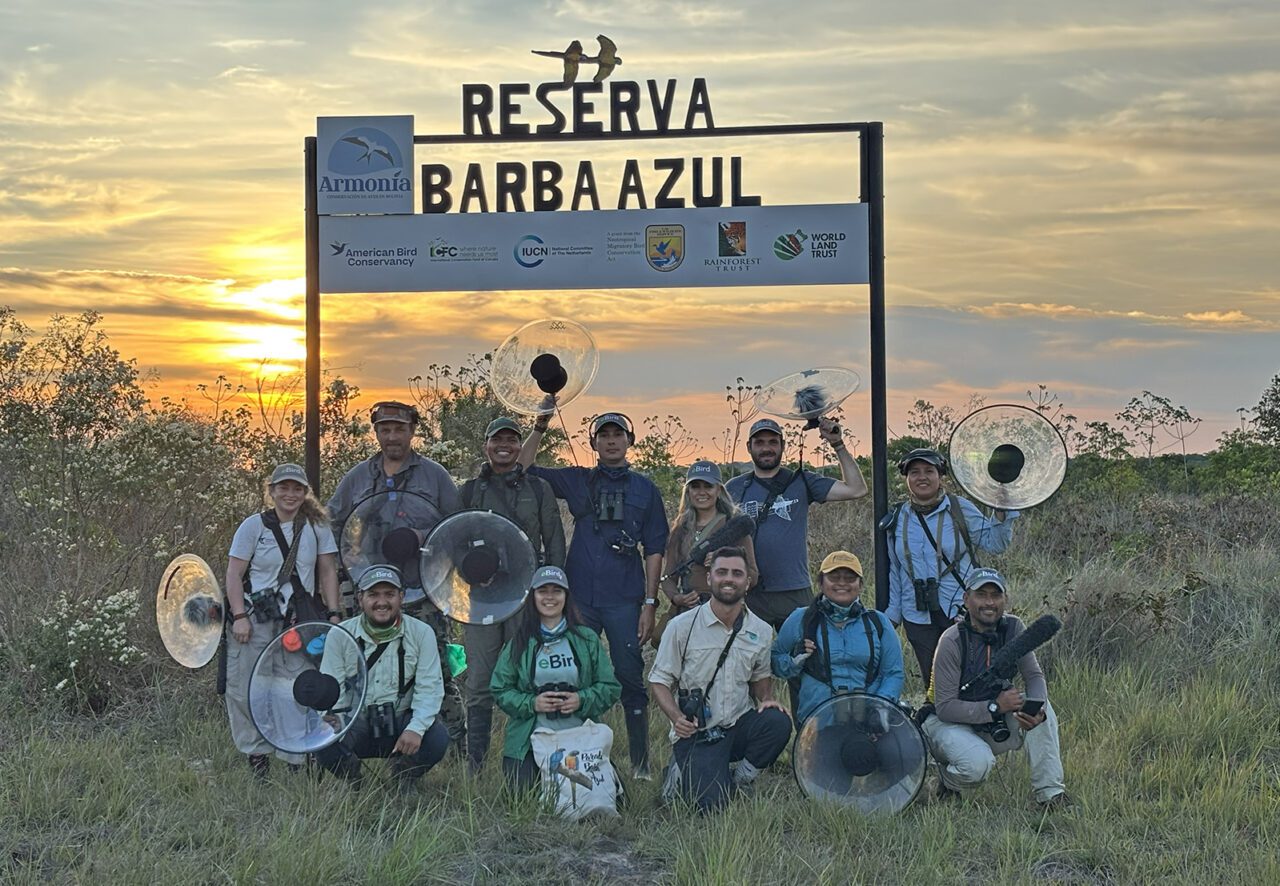
Photo: The expedition participants. Top row, left to right: Giselle Mangini, Cullen Hanks, Carlos Proaño, Mauricio Cuellar-Ramirez, Pierina Bermejo, Fabricio Gorleri, Nicole Avalos. Bottom row, left to right: Miguel Montenegro, Priscila Pellissier Pérez, Pablo Gigy, Daisy Utitiak, Jose Augusto Mérida Misericordia.
Each participant contributed their experience, stories, and enthusiasm, strengthening the great Latin American family that eBird and the Macaulay Library have helped weave over time.
A historic finding: Dwarf Tinamou!
The most astonishing discovery was a population of Dwarf Tinamou (Taoniscus nanus) within the Barba Azul Reserve—one of the rarest and most enigmatic birds on the planet.
Although the species had recently been reported for Bolivia (van Els et al. 2025), it had never been confirmed within a protected area. The excitement was immense upon obtaining more than 30 recordings of the species—almost as many as of very common birds like the Rufous Hornero (Furnarius rufus).
Listen to and enjoy the Dwarf Tinamou audio recorded by Carlos Proaño, which won an award at the South American Bird Fair.
Carlos recounts:
“It was October 7, at 6:44 p.m. Darkness had already settled over the Bolivian savanna, and after a full day under the sun, we were exhausted but attentive to the last sounds of the day. Suddenly, the silence was broken by a song that sent shivers down my spine.
With my heart racing, I turned on the recorder and captured that sound in the middle of the night. Later, when I shared the recording with my companions, they confirmed what I barely dared to imagine: it was the Dwarf Tinamou, one of the most elusive species in the region.”
Barba Azul Reserve: a refuge for biodiversity
Created by Asociación Armonía in 2008 to protect the habitat of the Blue-throated Macaw, the reserve covers 12,200 hectares. Only 5% of the area is used directly by the species for feeding and resting, while the remaining 95% preserves an extraordinary diversity of grasslands where other threatened species thrive.
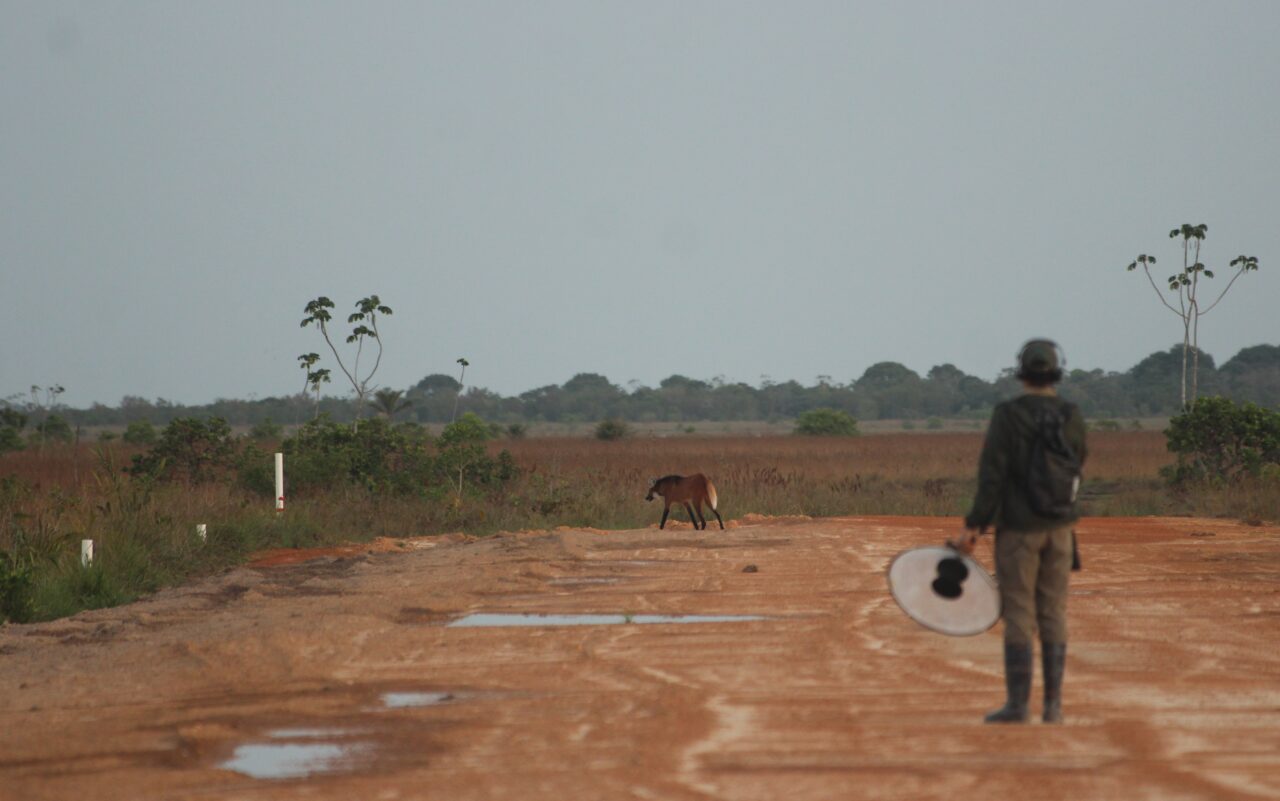
Photo: A close encounter with the Maned Wolf.
Notable among these are the Cock-tailed Tyrant (Alectrurus tricolor), the Black-masked Finch (Coryphaspiza melanotis), and the Buff-breasted Sandpiper (Calidris subruficollis), whose populations are sustained through habitat management.
Visit Barba Azul
Learn more and plan your visit to the reserve at:
https://armoniabolivia.org/wildlife-and-bird-watching-holiday-in-boliva/
Fire control and livestock exclusion have enabled ecological restoration of the ecosystem: over the past decade, the return of the Maned Wolf (Chrysocyon brachyurus), the Bush Dog (Speothos venaticus), the Jaguar (Panthera onca), and now the Dwarf Tinamou has been recorded—clear indicators of conservation success.
Thanks to the support of multiple institutions, Barba Azul has become a key refuge for biodiversity and features a lodge where visitors can experience firsthand the natural richness of Beni.
Toward a Latin American network of sound recordists
Recording birds does not require expensive equipment: a cellphone, attentiveness to the surroundings, and curiosity are enough. Each audio file tells a story—of a person, a landscape, and a bird—and together they form the living symphony of the Neotropics.
While this expedition added a significant volume of recordings from Beni, Bolivia, more Macaulay Library Sound Expeditions will soon take place in South America, especially in the Amazon basin, where hundreds of species still lack sufficient recordings to train sound identification models with the desired accuracy.
The next ML Sound Expedition will take place in Los Amigos (Peru) in February 2026, and new expeditions open to community participation are already being planned to continue strengthening this network of sound recordists committed to citizen science and conservation.
Text written by: Priscila Pellissier Pérez, Fabricio C. Gorleri, Cullen Hanks, Tjalle Boorsma & Nicole A. Avalos